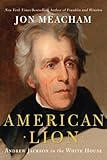
American Lion: Andrew Jackson in the White House
| Similar Items: | |
| Editorial Reviews: Product Description Andrew Jackson, his intimate circle of friends, and his tumultuous times are at the heart of this remarkable book about the man who rose from nothing to create the modern presidency. Beloved and hated, venerated and reviled, Andrew Jackson was an orphan who fought his way to the pinnacle of power, bending the nation to his will in the cause of democracy. Jackson’s election in 1828 ushered in a new and lasting era in which the people, not distant elites, were the guiding force in American politics. Democracy made its stand in the Jackson years, and he gave voice to the hopes and the fears of a restless, changing nation facing challenging times at home and threats abroad. To tell the saga of Jackson’s presidency, acclaimed author Jon Meacham goes inside the Jackson White House. Drawing on newly discovered family letters and papers, he details the human drama–the family, the women, and the inner circle of advisers–that shaped Jackson’s private world through years of storm and victory. One of our most significant yet dimly recalled presidents, Jackson was a battle-hardened warrior, the founder of the Democratic Party, and the architect of the presidency as we know it. His story is one of violence, sex, courage, and tragedy. With his powerful persona, his evident bravery, and his mystical connection to the people, Jackson moved the White House from the periphery of government to the center of national action, articulating a vision of change that challenged entrenched interests to heed the popular will–or face his formidable wrath. The greatest of the presidents who have followed Jackson in the White House–from Lincoln to Theodore Roosevelt to FDR to Truman–have found inspiration in his example, and virtue in his vision. Jackson was the most contradictory of men. The architect of the removal of Indians from their native lands, he was warmly sentimental and risked everything to give more power to ordinary citizens. He was, in short, a lot like his country: alternately kind and vicious, brilliant and blind; and a man who fought a lifelong war to keep the republic safe–no matter what it took. Jon Meacham in American Lion has delivered the definitive human portrait of a pivotal president who forever changed the American presidency–and America itself. Exclusive Amazon.com Q&A with Jon Meacham and H.W. BrandsOn the eve of the historic 2008 presidential election, we were fortunate to chat with historians Jon Meacham and H.W. Brands (author of Traitor to His Class: The Privileged Life and Radical Presidency of Franklin Delano Roosevelt) on the similarities of their presidential subjects and how the legacies of FDR and Jackson continue to shape the political world we see today. Amazon.com: One of Andrew Jackson's childhood friends once remarked that when they wrestled, "I could throw him three times out of four, but he never stayed throwed." How emblematic is this of Jackson's career? Meacham: Utterly emblematic. Jackson was resilient, tough, and wily, rising from nothing to become the dominant political figure of the age. He was crushed by his loss in 1824, when, despite carrying the popular vote, he was defeated in the House of Representatives. But, tellingly, he began his campaign for 1828 almost immediately, on the way home to Tennessee. And he won the next time. Amazon.com: What would Jackson think of Franklin Delano Roosevelt? Meacham: I think they would have gotten along famously. It is difficult to imagine men from more starkly different backgrounds?to take just one example, Jackson lost his mother early, and FDR was long shaped by his mother?but they both viewed the presidency the same way: they both believed they should be in it, wielding power on behalf of the masses against entrenched interests. Amazon.com: How important was Jackson's legacy to FDR's Presidency? Brands: Jackson was FDR’s favorite president, and Jackson’s presidency was the one Roosevelt initially modeled his own after. FDR saw Jackson as the champion of the ordinary people of America; he saw himself the same way. He compared Jackson’s battle with the Bank of the United States to his own battle with entrenched economic interests. And just as Jackson had reveled in the enmity of the rich, so did Roosevelt. Amazon.com: Although both were regarded as champions of the people, their backgrounds were drastically different. FDR hailed from a wealthy and politically-connected family, while Jackson was an orphaned son of immigrants. How did each manage to endear themselves to the voters of their day? Meacham: Jackson was in many ways the first great popular candidate. He had “Hickory Clubs,” and there were torchlit parades and barbecues?lots and lots of barbecues. Jackson helped mastermind the means of campaigning that would become commonplace. He also intuitively understood the power of image, and kept a portrait painter, Ralph Earl, near to hand in the White House. Brands: FDR combined noblesse oblige with felt concern for the plight of the poor. His polio had something to do with this?it introduced him to personal suffering, and it also introduced him, in Georgia, where he went for rehabilitation, to poor farmers unlike any he had spent time with before. He came to know them and to feel the problems they faced. He took people in trouble seriously and communicated that seriousness to them. Continue reading this Q&A | |
Customer Reviews: Read 18 more reviews... Too Caught Up with Jackson the Person. December 21, 2008 Too Caught Up with Jackson the Person. December 21, 2008Joseph Faraldo (NYC) To learn of the early days of Jackson and the personal loss that accompanied the days shortly after his election, is interesting but the the detailed treatment of and by the wives of cabinet members in the first half of the book brings the work down to a level of near gossip column status. Jackson's struggles to make for a stronger Presidency may have been part of what appears to be an overconsuming control personality and the real lack of concern about anything that got in the way. At least that's the impression i got so far and at least whatever it was that drove him, he was on the right side of the question of Democracy. When the book reverts back to what positions he took on earlier efforts to divide the Union, which are generally overlooked because they didn't precipitate a crisis in American history at the time, may make one wonder if their were times he really made decisions not based upon a matter of his sheer will. The book does at least get one to refocus on perhaps the first Democratic President of the United States. There is always something to learn from the experiences of men in positions of power who faced what appeared, at the time, to be problems that would bring down a family or a nation.  I did want to like this book... December 21, 2008 I did want to like this book... December 21, 2008Bvus (Los Angeles) 3 out of 3 found this review helpful This review refers to the abridged audio version of this book. I really was looking forward to this book and unfortunately it was a disappointment. I read or listen to as many of the popular historical writings published lately as I can (including but not limited to the writings of David McCullough and Doris Goodwin). To date I have always enjoyed these works. I cannot include this book in with the ones I enjoyed. The introductory chapter relayed all that was to be covered in the rest of the book. The rest of the book contained detail, but little detail of interest. A substantial portion of the book was spent describing a social snub of the wife of Jackson's Secretary of War and Jackson's attempts to revoke the charter of the national bank. Interesting to a historian, but there had to have been more important things to focus on than this in this legendary president's two terms in office. I understand the author used these issues to illustrate Jackson was stubborn and loyal and that was probably brought about by him not having a strong family environment when he grew up. This is not enough to sustain an entire book. The author taking the bold position that Jackson's views on slavery and the indians were wrong in hindsight did not make Jackson appear flawed or complex as it appeared the author intended. He described Jackson as a heroic figure, but in the end did not back it up with evidence to show it. He would describe Jackson as livid as he had ever been and then describe the scathing letter that Jackson would send out in protest. Old Hickory sure sent a lot of letters. The reader for the audiobook was the worst I have ever experienced. On that alone, I almost stopped listening to the book. I drive a long route each day and there were times that I preferred to listen to radio commercials than the voice of the reader. He sounded like a '70's DJ. Worst of all were his quotations from Jackson that appear to have been made to make him sound heroic, but just made him out to sound like a pompous windbag. To add insult, he would use virtually the same voice to quote other people. I find it hard to believe everyone in the early 1800's sounded like a jerk. If you don't read many books in this genre, I would recommend McCullough's book on Adams instead for a better idea of what these types of books can be.  Tremendous!!!! December 18, 2008 Tremendous!!!! December 18, 2008BookWoman/BookMan TV REVIEWS (Nashville, Tn United States) 1 out of 2 found this review helpful "It takes a native Tennessean to interpret the life of one of Tennessee's most controversial and powerful leaders. Meacham does a tremendous job." Rich, gracefully written biography December 15, 2008Bookreporter.com (New York, New York) 7 out of 7 found this review helpful I've always had something of an affinity for Andrew Jackson. Perhaps it's nothing more than the fact that we share a birthday (March 15th). Or maybe it's because he's generally regarded as one of the progenitors of the modern Democratic Party, of which I've been a member for almost 40 years. But now, after reading Newsweek editor Jon Meacham's rich, gracefully written biography of our seventh president, I've discovered new reasons to admire this colorful and controversial leader for the decisive role he played in shaping the modern presidency in the midst of a turbulent period of American history. Drawing upon a diverse and impressive array of sources, including letters in private hands for 175 years, Meacham (like Jackson a Tennessean) paints what he describes as "not a history of the Age of Jackson but a portrait of the man and of his complex relationships with the intimate circle that surrounded him as he transformed the presidency." Born in humble circumstances and orphaned by the age of 14, Jackson rose to the pinnacle of power amidst the rude environment of the American frontier. He killed a man in a duel and was a ruthless military leader, whose victory over the British at the Battle of New Orleans in 1815 catapulted him to national prominence. After winning a plurality of the popular vote and then losing the 1824 election to John Quincy Adams in the House of Representatives, Jackson captured a decisive 56 percent majority in 1828. Two dramatic political battles marked Jackson's presidency: the conflict surrounding the nullification doctrine advanced by the state of South Carolina and its chief advocate John Calhoun (Jackson's first-term Vice President), by which it claimed the right to reject laws passed by Congress, and the fight over the charter renewal of the Second Bank of the United States. Despite his belief in the principle of states' rights and the desirability of a limited federal government, Jackson maintained an unshakeable determination to preserve the unity of the new nation. "Convinced that the Union should stand strong, with the people at its mystical center," writes Meacham, "Jackson did not believe any amount of Southern sophistry --- as he would have seen it --- could destroy America." In the case of the Bank, Jackson saw himself as "the embodiment of the people standing against entrenched interests" and prevailed in his effort to block the renewal of the Bank's charter, enduring withering criticism and the formal censure of the Senate in the process. Meacham connects Jackson in a straight line to Abraham Lincoln, the next great president after a forgettable string of eight, ranging from mediocre to abysmal (Van Buren to Buchanan). Indeed there's even a link between the two, as Jackson named a 24-year-old Lincoln to the job of postmaster of New Salem, Illinois in 1833. Anyone not intimately familiar with the history of the Jackson era will come away from this account with an appreciation of the fact that had it not been for Jackson's determination to quell the threat of Southern secession there may have been no Union left for Lincoln to preserve a generation later. While his portrayal of Jackson clearly is sympathetic, Meacham makes no attempt to deify his subject. Jackson was a slave owner, "blinded by the prejudices of his age," and never questioned the morality of that despicable practice. And he had no qualms about supporting the forced relocation of Native American tribes, culminating in the Cherokee "Trail of Tears," in which nearly a quarter of the Cherokee Nation disappeared. These less attractive aspects of Jackson's character are balanced against Meacham's portrait of "Old Hickory" as a tender and attentive family man, dependent on his niece Emily Donelson, who served as White House hostess when Jackson's wife Rachel died shortly after the 1828 election, and her husband Andrew, his political confidante. "The idea and image of a strong president claiming a mandate from the voters to unite the nation and direct the affairs of the country from the White House took permanent root in the Age of Jackson," Meacham concludes. Reading those words, it's hard not to appreciate their relevance on the eve of a new presidential administration owing its victory, in large measure, to an extraordinary grassroots campaign. Thanks to this wise and nuanced portrait of Andrew Jackson, it's possible to see the historical link between these eras, no matter how improbable the outcome might have appeared to Barack Obama's predecessor of nearly two centuries ago. --- Reviewed by Harvey Freedenberg (mwn52@aol.com) quality biography December 14, 2008David Yennior (Belleville, NJ) 1 out of 2 found this review helpful The book was a gift from me to a fan of Andrew Jackson. So far my friend cannot put the book down. She said it is good reading. |
List Price: $229.00Price: $209.00You Save: $20.00 (9%)11 used & new from Too low to displayHere it is! A 720p HD camcorder that fits in your pocket. The Flip MinoHD has 4GB built-in memory to record a ...
List Price: $32.99Price: $17.12You Save: $15.87 (48%)30 used & new from $10.45for use with SDHC-compatible devices only * 8GB capacity * 2MB per second minimum sustained write capability *(read more)
List Price: $179.95Price: $99.97You Save: $79.98 (44%)23 used & new from $99.00Your first step in car navigation? TomTom ONE combines ease of use, portability, TomTom's touchscreen technology and a sl ...
List Price: $599.99Price: $254.49You Save: $345.50 (58%)58 used & new from Too low to displayGarmin's n?vi 700 series brings two exciting new features -- multi-destination routing and, "Where am I?/Wh ...
List Price: $279.99Price: $182.99You Save: $97.00 (35%)36 used & new from Too low to displayThe Garmin n?vi 360 GPS Navigator and Personal Travel Assistant is a GPS navigator, personal translator, mul ...
List Price: $48.99Price: $27.56You Save: $21.43 (44%)20 used & new from $26.05Fully Compatible with SDA 2.0 specification. Suitable for SDHC compliant devices, MLC flash chip with High Speed transfer ...
List Price: $429.99Price: Too low to display10 used & new from Too low to displayThe Asus Eee PC 1000HA provides the power of a full-sized laptop in a compact body with an extra-large 10-inch screen, ...
List Price: $279.99Price: $169.95You Save: $110.04 (39%)10 used & new from Too low to displayColor communicates. It introduces you before you say a word, making the PowerShot SD1100 IS Digital ELPH th ...
List Price: $299.99Price: $206.99You Save: $93.00 (31%)2 used & new from $206.98Garmin n?vi 750 4.3-Inch Widescreen Portable GPS Navigator with Portable Dashboard Mount Included(read more)
List Price: $109.99Price: $62.99You Save: $47.00 (43%)1 used & new from $62.99SPF-71E USB DIGITAL PHOTO FRAME - 7IN SECONDARY LCD SD/MMC/USB READER(read more)


 Posts
Posts


No comments:
Post a Comment